Modern Ecommerce App Development: Technologies, Costs & Growth Strategies

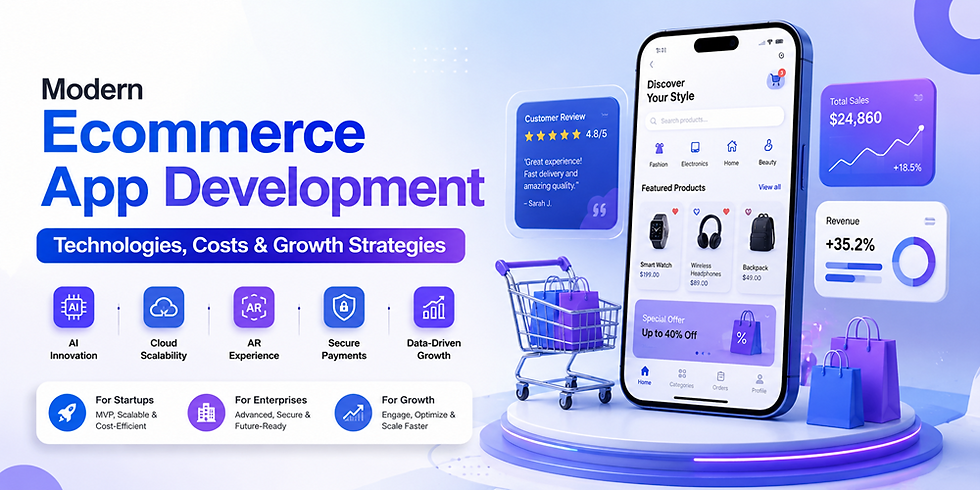
In today’s digital-first economy, Ecommerce App Development has become a critical investment for businesses aiming to deliver seamless shopping experiences and drive sustainable growth. As mobile commerce continues to dominate online retail, businesses are increasingly adopting advanced technologies to create scalable, user-friendly, and high-performing applications.
Whether you are a startup launching your first online store or an enterprise expanding digital operations, understanding the technologies, costs, and growth strategies behind modern ecommerce applications is essential for long-term success.
Why Ecommerce Apps Are Driving Digital Commerce Growth
Consumers now prefer shopping through mobile applications because of convenience, speed, and personalized experiences. This shift has increased the demand for Ecommerce Mobile App Development across industries, including fashion, healthcare, electronics, grocery, and B2B commerce.
Some major advantages of ecommerce apps include:
Improved customer engagement and retention
Faster checkout experiences
Personalized product recommendations
Enhanced brand visibility
Higher conversion rates
Better customer data collection and analysis
Businesses investing in Ecommerce Application Development can create stronger customer relationships while generating new revenue opportunities through mobile channels.
Key Technologies Powering Modern Ecommerce Apps
Modern ecommerce applications leverage advanced technologies to improve performance, security, and customer experiences.
Artificial Intelligence (AI)
AI helps ecommerce businesses deliver personalized shopping experiences through:
Product recommendations
Predictive analytics
Customer behavior tracking
Intelligent search functionality
Chatbots and virtual assistants
AI-driven features significantly improve customer satisfaction and increase sales conversions.
Cloud Computing
Cloud infrastructure allows businesses to scale their ecommerce platforms efficiently.
Benefits include:
High availability
Improved performance
Faster deployment
Enhanced security
Reduced infrastructure costs
Many organizations integrate cloud-based solutions as part of their Ecommerce App Development Services to ensure business continuity and scalability.
Augmented Reality (AR)
AR technology allows customers to visualize products before making purchases.
Examples include:
Virtual try-ons
Furniture placement previews
Product visualization tools
This technology helps reduce return rates while increasing customer confidence.
Secure Payment Integration
Modern ecommerce applications support multiple payment methods, including:
Credit and debit cards
Digital wallets
UPI payments
Buy Now Pay Later (BNPL)
Cryptocurrency payments
Secure payment gateways remain a crucial component of custom ecommerce app development services.
Essential Features of a Successful Ecommerce App
Businesses planning Custom Ecommerce App Development should focus on features that improve customer experiences and operational efficiency.
Customer-Focused Features
User registration and profiles
Product catalog management
Advanced search and filtering
Personalized recommendations
Wishlist functionality
Multiple payment options
Real-time order tracking
Push notifications
Business Management Features
Inventory management
Analytics dashboards
Customer management
Marketing automation
Order management systems
Loyalty and rewards programs
These features contribute to better operational control while supporting business growth.
Understanding Ecommerce Mobile App Development Cost
One of the most common questions businesses ask relates to ecommerce mobile app development cost. The total investment depends on multiple factors.
Development Factor | Impact on Cost |
App Complexity | Higher functionality increases cost |
Platform Choice | iOS, Android, or both |
UI/UX Design | Custom designs require more resources |
Third-Party Integrations | Payment, CRM, ERP, and logistics integrations |
Advanced Features | AI, AR, analytics, and personalization |
Development Team Location | Regional pricing differences |
Estimated Cost Range
Basic Ecommerce App: $10,000–$30,000
Mid-Level Ecommerce App: $30,000–$80,000
Enterprise Ecommerce Platform: $80,000–$250,000+
Businesses should focus on long-term value rather than only initial development expenses when evaluating project budgets.
Ecommerce App Development for Startups
For emerging businesses, ecommerce app development for startups should prioritize speed, scalability, and cost efficiency.
Recommended strategies include:
Launching with an MVP (Minimum Viable Product)
Prioritizing core shopping features
Choosing scalable cloud infrastructure
Implementing secure payment systems
Using analytics from day one
Startups can gradually add advanced features based on customer feedback and market demand.
Key startup benefits include:
Faster market entry
Lower development risk
Better resource allocation
Easier product validation
A strategic development roadmap helps startups achieve growth without overspending on unnecessary functionality.
Ecommerce App Development for Enterprises
Large organizations have more complex requirements, making ecommerce app development for enterprises significantly different from startup projects.
Enterprise ecommerce platforms often require:
Multi-vendor capabilities
Advanced inventory management
ERP integration
CRM integration
Multi-language support
Multi-currency functionality
Advanced security frameworks
High-volume transaction processing
Enterprise businesses must also focus on scalability, compliance, and long-term digital transformation goals.
Working with experienced providers offering ecommerce application development services can help enterprises build robust and future-ready digital commerce ecosystems.
Growth Strategies for Ecommerce Success
Building an app is only the beginning. Sustainable growth requires a strategic approach.
Personalization
Personalized experiences improve customer engagement and increase purchase frequency.
Omnichannel Experiences
Businesses should connect mobile apps, websites, social media platforms, and physical stores to create a unified customer journey.
Data-Driven Decision Making
Analytics help organizations understand:
Customer behavior
Purchasing trends
Product performance
Marketing effectiveness
Customer Retention Programs
Loyalty programs, rewards, and personalized offers encourage repeat purchases and increase customer lifetime value.
Continuous Optimization
Regular updates, feature enhancements, and performance improvements ensure the application remains competitive in a rapidly evolving market.
Businesses investing in professional Ecommerce App Development Services can better adapt to changing consumer expectations and market demands.
Conclusion
The future of digital commerce depends heavily on innovative Ecommerce App Development strategies that combine advanced technology, seamless user experiences, and scalable infrastructure. Whether pursuing Ecommerce Mobile App Development for a growing startup or implementing Custom Ecommerce App Development for a large enterprise, businesses must align technology investments with long-term growth objectives.
By leveraging modern technologies, understanding development costs, and adopting effective growth strategies, organizations can maximize the value of their Ecommerce Application Development initiatives. Partnering with experts offering reliable ecommerce application development services and custom ecommerce app development services can help businesses create powerful digital commerce platforms that drive revenue, customer engagement, and sustainable success.


Comments